Hybrid AI & Archimedes’ Law Innovation Delivers 97% Accuracy, Meeting the Demands of Mining 5.0 Era
As the mining industry accelerates into the era of Mining Industry 5.0, the demand for uncompromising data accuracy has reached an all-time high. Addressing this global challenge, an Indonesian academic has made a significant breakthrough on the international stage.
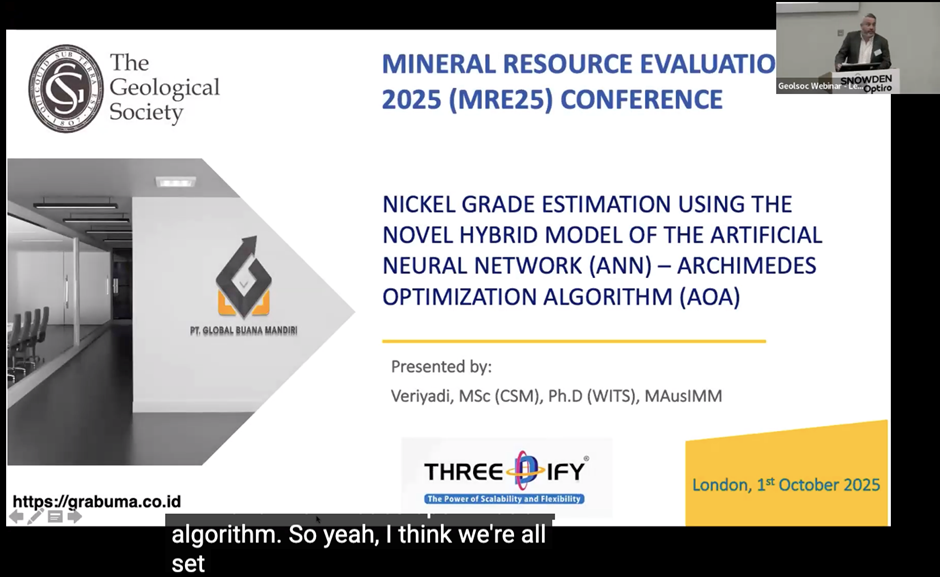
Veriyadi, M.Sc., Ph.D., a lecturer in Mining Engineering at the Bandung Institute of Science and Technology (ITSB), introduced a revolutionary hybrid method that combines Artificial Neural Networks (ANN) with the Archimedes Optimization Algorithm (AOA). This method is claimed to significantly boost the accuracy of ore grade estimation, particularly for nickel.
Bringing AI Underground
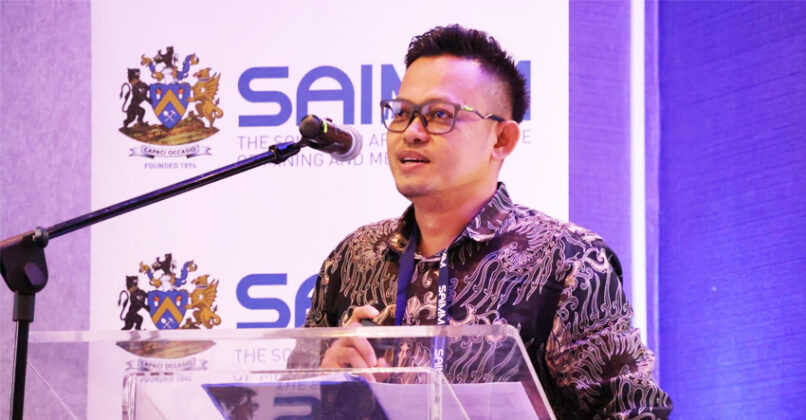
The innovation, dubbed the ANN–AOA Hybrid Method, was presented by Veriyadi at the prestigious Mineral Resource Estimation Conference 2025 in London. It immediately garnered attention by offering a concrete solution to the shortcomings of conventional estimation methods.
Veriyadi explained that classic methods like Inverse Distance Weighting (IDW) and Ordinary Kriging (OK) rely primarily on distance or spatial correlation. Their performance often collapses when dealing with “messy” geological data (non-linear, non-stationary, and heteroskedastic)—conditions very common in lateritic nickel deposits.
“The factors determining grade estimation are not just distance or spatial correlation. Other geological variables, such as lithology, cobalt grade, iron, MgO, SiO₂, and even location factors also play a role. The hybrid method allows all these variables to be included and optimized,” said Veriyadi, who also serves as the CEO of PT Grabuma.
Where the Human Brain Meets Physical Laws
How does this “new formula” work?
The hybrid method leverages two main powers:
- ANN (Artificial Intelligence): Acts as an artificial brain, mimicking the human neural network to recognize highly complex data patterns.
- AOA (Archimedes Algorithm): Serves as the optimizer. This algorithm adopts the principle of Archimedes’ Law—the calculation of an object’s volume in water—and converts it into an algorithm to ensure the ANN’s performance reaches its optimal point.
“The combination of the two significantly increases estimation performance,” he asserted.
Proof in the Data: Accuracy Skyrockets to 97%
In the case study conducted on a nickel deposit, the results were striking. The ANN–AOA Hybrid Method outperformed all its competitors, including standard ANN.
Here is a comparison of accuracy (using the R2 value):
| METHOD | RMSE (Error) | R2 (Accuracy) |
| ANN–AOA Hybrid | 0.20 | 0.97 (97%) |
| Standard ANN | 0.27 | 0.89 |
| IDW | 0.50 | 0.67 |
| OK | 0.56 | 0.56 |
“The ANN–AOA Hybrid is proven to be more accurate than OK, IDW, or standard ANN. The results are measurable and verifiable through a fair training and testing process,” Veriyadi stated.
The Future of Mineral Estimation
Although his initial study focused on nickel, Veriyadi is optimistic that this hybrid method can be broadly applied to the grade estimation of other metal commodities, such as gold, copper, and tin.
“With the demands of Mining Industry 5.0 emphasizing Artificial Intelligence (AI), the need for accurate and efficient grade estimation is no longer an option, but a necessity. The implementation of AI in grade estimation is not a choice, but a requirement,” he concluded, expressing confidence that the ANN–AOA Hybrid Method will become the new standard in mineral resource management in the coming years.
source: nikel.co.id